


Colloquial Persian
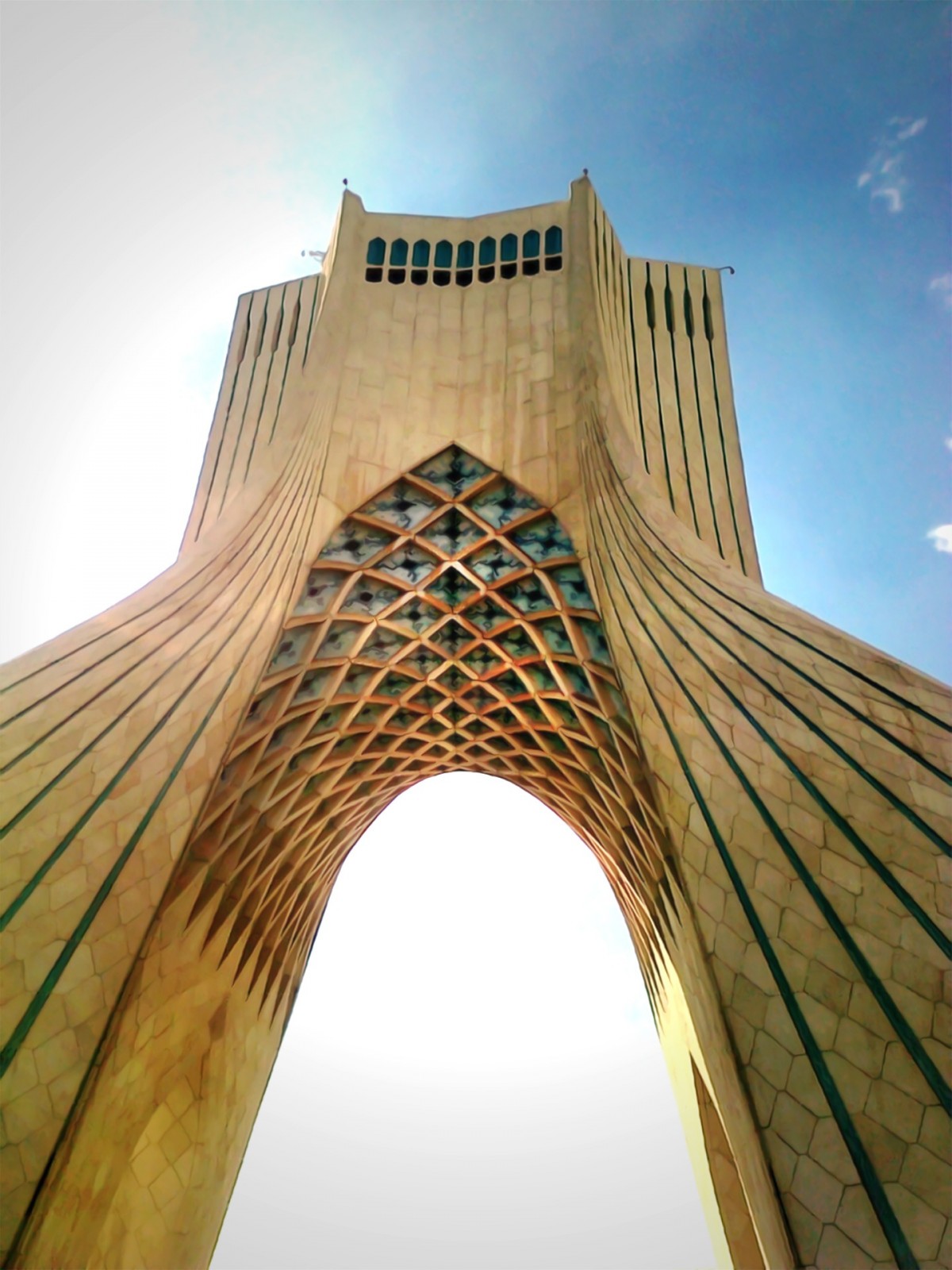
Azadi tower, the symbol of modern Tehran
The main grammar lessons on this website are based on Formal Persian. Formal Persian is the language used in books, newspapers, TV news broadcasts, poems, formal speeches, etc. It is the standard written form of the language and its Iranian, Afghan and Tajik versions are very similar. However, people use Colloquial (spoken) Persian in everyday conversations. Colloquial Persian has significant differences from Formal Persian, and varies from place to place (for a technical summary of the main differences between Formal Persian and Colloquial Persian, see this paper). In this section, you will learn the version spoken in Tehran. Even though this variety is often called Tehrani Persian, it has in fact become a standard in many regions of Iran (at the expense of local varieties) and is spoken by millions of Iranians outside of Tehran, especially among the young and educated classes.
The difference between Colloquial Persian and Formal Persian is much deeper than the difference between colloquial and written English. Unlike the case of English, they should really be viewed as two independent (but very close) language varieties. However, while understanding a Tehrani speaking might be difficult for a learner familiar only with written Persian, one must keep in mind that by learning a handful of essential rules you can quickly fill the gap. I have presented in this section these grammatical and phonological rules as well as differences in vocabulary between the two forms of Persian.
I have chosen the Tehrani version of Persian as the standard for this website
because it is by far the dominant spoken form of the language. With more than 9 million inhabitants, the city of Tehran by itself is well ahead of the whole of Tajikistan in population. The number of films, books, songs and blogs written and produced
in Tehran is higher than the combination of all of the other cities in the Persian-speaking world. Even in other Iranian cities,
cultural products and written colloquial conversations are mainly based on the Tehrani accent.
Inside Iran, other major accents are those of Isfahan, Shiraz, Yazd and Mashhad. They have faced decline since the rise of Tehran in political power 200 years ago. It is not uncommon for a Yazdi, for instance, to try to speak like Tehranis
when visiting Tehran, but the opposite case is extremely rare.
After the Tehrani accent, the accent that is most likely to be heard in Iranian media is the Isfahani accent. It is distinguished by its uniquely different intonational system (note for nerds: the pitch accent is realized as a low tone in Isfahani but as a high tone in other Persian varieties). Among other notable features of the Isfahani
accent are using "es" instead of the Tehrani "e" for "is" (corresponding to Formal Persian "است") and using "i" instead of the Tehrani "e" for "ezafe".
A crucial point to note here is that in learning Persian, learning the colloquial form is a necessity. In order to communicate with
ordinary people, one must learn the spoken form of the language. The formal variety is well
understoond but sounds very awkward for everyday speech. Tehrani accent is fully understood and appreciated all over Iran,
and it is not unfamiliar to the ears of Persian speakers outside of Iran either.
Today, Tehrani Persian has gone beyond being merely a "spoken" form of Persian. Seeing blogs, song lyrics, movie subtitles , and
even books written in colloquial Tehrani Persian is not a surprise anymore. In fact, with the spread of technology, most Iranians use Colloquial Persian more than Formal Persian in what they write daily.